Suffocating ancient Roman flower fests, 'Ceres' the goddess of grain & Tuscan flowers for foodies 💐
Updated: Dec 17, 2025
From laurel wreaths, to rose petals and zucchini blossoms, today's blog is mostly about Tuscan flowers in ancient and modern times.
One of the most notorious stories involves the transexual Roman Emperor Elagabalus (also known as Heliogabalus, who reigned from 218 to 222 AD), remembered for hosting extravagant banquets that veered into cruelty. Ancient sources claim that during these feasts he ordered vast quantities of rose petals to be dropped from a concealed ceiling, burying diners beneath the perfumed deluge and, in some accounts, suffocating those who could not free themselves in time.

At certain banquets, he would release petals from the ceiling until indulgence tipped into suffocation, pleasure smothered by its own excess. Flowers, after all, had long signalled luxury, softness, scent, and beauty ~ i.e. the good life. The Roman celebration of Floralia embraced this logic. Bouquets were carried around and petals often fell in deliberate abundance; naked dancing and laden food platters followed as guests eventually reclined in carefully staged excess. It was a festival of spring and flowers, of officially sanctioned prostitution, where restraint was unfashionable and beauty always carried a faint threat.

Below is a painting by the artist Lawrence Alma-Tadema 1836–1912, who was renowned for his vivid portrayals of Roman life, often emphasising its extravagant over-the-top (often fantasised) luxury. At first glance in this painting it appears that some guests seem merely drowsy, overcome by wine and merrymaking, but on closer inspection exists a darker reality featuring several figures lying motionless with eyes open - fatally smothered beneath the overwhelming cascade of flowers dominating the painting. Bit "suss" I'd say... The painting is called The Rose of Heliogabulus.
Death by a thousand flower petals •᷄I •᷅

Alma-Tademe's painting draws on an anecdote recorded in the Historia Augusta, a late Roman collection of imperial biographies. According to this account, Emperor Elagabalus released a mass of violets and other blossoms, rather than roses, from a ceiling designed to open and close. It is ambiguous as to whether these deaths were intentional or the unintended result of excess, but if the episode has any basis in fact, Elagabalus may have been following the example of another notorious ruler, Nero (r. 54–68 CE), whose palace featured a similar mechanical ceiling used to shower diners with flowers and perfume, as described by Suetonius.

Imagine a ceiling opening up and being showered by flowers and perfume these days, now that's a show stopper and one that Elagabalus and the notorious Emperor Nero would approve of. 🌸 🗡️ 🌸
Obviously, not all Roman parties were about getting your kit off, as some were publicly held to honour the gladiators or the auxiliary, centurions, legionaries, and tesserarius', amongst others. This primary Roman celebration that honoured a victorious military commander and his soldiers was called the Roman Triumph or triumphus. An elaborate civil and religious ceremony was essentially a grand parade and popular festival designed to celebrate military success and give thanks to the gods, especially to Jupiter.

Soldiers and commanders processed through the city crowned with laurel ~ sacred to Jupiter and symbolic of victory; while garlands and greenery decorated standards, temples, and public spaces. The ceremony was accompanied by public banquets and popular games (ludi) and entertainments for the Roman populace, which could last for several days. Roses and garlands were used ornamentally at these public celebrations. 🌺

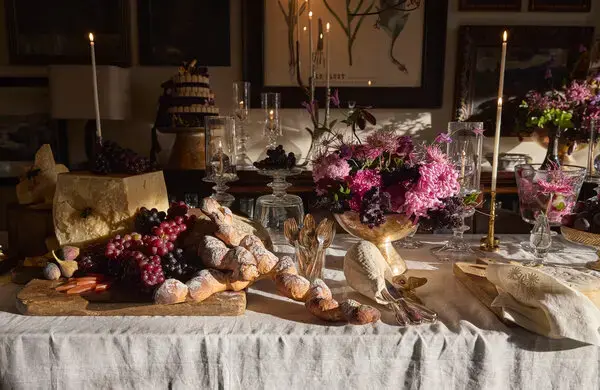
Just as laurel once adorned commanders and public spaces during days of celebration, a restrained arrangement of florals brings meaning without excess. Against a neutral backdrop, carefully chosen blooms can still support celebrations while maintaining modern elegance... Refined, intentional, and far safer and more low key than the lavish Roman banquets where petals famously rained from above.

An example of simplicity would be this exquisite, elegant and subtly colourful table setting, where the neutral wall is the perfect backdrop for an array of floral detail and enticing buffet cuisine. The polar opposite of bountiful Roman decadence!

Similarly, the tradition of scattering petals at weddings traces back to ancient Roman customs, where young girls that were earlier versions of today’s flower girls, walked ahead of the bride scattering grains, herbs, or seeds such as wheat or oats. 🎊 All thanks to the Roman Goddess of Agriculture, Ceres. Nowadays, we mostly throw petals or biodegradable confetti which is a tad less painful than grains to the face.

These seasonal offerings symbolised fertility, prosperity, and abundance, and were closely linked to Roman beliefs and deities. The ritual was meant to bless the couple with good fortune and a fruitful future together.⋆.ೃ࿔*:・·˚ ༘ Today, flowers remain powerful markers of abundance, though their role is largely decorative. Whether arranged alongside food, incorporated into the table presentation, or layered into lush background décor, the vibrant petals and glossy green leaves bring colour, natural beauty, and style to any occasion. The best host does flowers!


Some Roman mosaics featured rich floral designs, including acanthus leaves and scrolling patterns, bringing nature's beauty into the bathing spaces. The Roman Baths in Bath, England feature significant figures like the iconic Gorgon's Head, which is a mix of Celtic and Roman imagery, possibly a water god or Celtic "Green Man" on the temple pediment and the rare, gilt bronze head of Sulis Minerva, the goddess worshipped there, alongside Victorian statues of Roman emperors and governors of Bath.
In Italy, flowers have always been used in food, as much in their decorative role in ancient Roman feasting and festivity. Long before they became decorative flourishes, Tuscan blossoms were gathered with intent by Etruscans, Romans, monks, and farmers. Each bloom, herb or spice valued for its flavour, nourishment, and quiet usefulness. From saffron harvested by hand to borage and elderflower picked along country paths, a variety of flora entered the kitchen as part of everyday life, shaped by season and necessity rather than excess... Incidentally, saffron is apparently really great for mood enhancement and lifting depression, so there.

Flowers were more than decoration, they were food plucked straight from the garden. Roses and violets flavoured wine, sweetened desserts with honey, and brightened everyday meals, while their scents and healing properties were believed to nourish the body as much as the senses. For Romans, eating flowers was a way to taste nature itself, turning simple blooms into symbols of pleasure, health, and abundance.
Roman parties, known as convivium (banquets) or comissatio (drinking parties) were lavish affairs mainly - and rather irritatingly - for society's elite. Featuring multiple courses, entertainment such as poets, musicians, dancers, sometimes exotic animals, and lots of wine, they were mostly held in dining rooms (triclinia) with guests reclining on couches, while the Bacchanalia were wild cultic celebrations for the wine god Bacchus, and public festivals like Saturnalia involved general revelry, feasting, and even gambling, showcasing everything from refined social gatherings to decadent, history-making events.
Pause for thought... How can I install a ceiling trap door that drops a sh*t ton of petals on my friends?

The flowery traditions endured through centuries of rural cooking in Italy, where cucina povera transformed what was freely available into something sustaining and memorable. Zucchini blossoms were fried when the vines were heavy with growth; chamomile and wild fennel scented broths and infusions; roses and violets appeared sparingly in sweets. Today, as Tuscan cooks still enjoy these practices, flowers continue to offer what they always have: a subtle pleasure, a connection to the land, and a reminder that beauty in this cuisine is often found in restraint.
Zucchini blossoms (fiori di zucca)
One of Rome’s most beloved dishes featuring cooked flowers is Fiori di Zucca Fritti, or fried zucchini blossoms. These delicate squash flowers are gently stuffed with creamy mozzarella or ricotta and savoury anchovies, then dipped in a light batter and fried until perfectly golden and crisp. The result is an irresistible bite that balances sweetness, saltiness, richness, and crunch. Although considered a modern Roman classic, the dish reflects a long-standing tradition in Roman cuisine of transforming humble, seasonal ingredients into something extraordinary, much like the iconic Carciofo alla Giudia. Together, these dishes celebrate the city’s love for sweet-savoury contrasts and the fleeting beauty of summer harvests.
The most iconic Italian edible flower. Often stuffed, fried, or used on pizza and also used to garnish dishes in summer.

CLICK to buy seeds for this flower
Lovely as dish decoration:


Borage flowers (fiori di borragine)
Pretty blue flowers used in Ligurian cuisine. Often placed on pasta or ricotta dishes.

Other catering flowers you may be interested in:
Nasturtiums (nasturzi)
| Rose petals
| Elderflowers (fiori di sambuco)
| Calendula (fiore di calendula)
|
Here's a suggestion for a trip in Firenze in mid-June/July, to an organic lavender farm where you can enjoy homemade products and beautiful views with the fragrances of floral Italian countryside:

Terrafranta is a working organic farm nestled in the hills of Florence, founded by Carlotta Chiocchini in 2020. Visit to enjoy the views of stunning lavender and gorgeous homemade products for sale.
"Pure linen bags filled with dried lavender flowers. Perfect to keep your clothes smelling nice and fresh in your wardrobe, to carry in your bag, to use as a pillow if you’re tired."

"Each kit comes in a customised sage green box, accompanied by a Terrafranta postcard designed by Céline Hurka and contains:- 100ml Organic Lavender Water - 20ml Organic Lavender Essential Oil
Our Officinal Lavender (Lavandula Angustifolia) is grown, harvested and processed by us, directly on our farm in Florence.
Our entire production is certified organic: the plants thrive on our east-facing hills, and require no treatments whatsoever. We do not use any type of machinery on our lavender field: everything is done by hand, from planting to harvesting to distilling.This ensures we obtain a 100% natural product in line with our philosophy."


Details on Terrafranta ~ Click here to visit the website

In Tuscany, the use of edible flowers carries a lineage that feels almost mythic, tracing back to ancient Rome where banquets were immersive spectacles and guests dined beneath showers of falling petals. Roses, violets, calendula, and borage were not only decorative but symbolic, woven into food, wine, and ritual to honour abundance and the cycles of nature. Again, these celebrations were closely tied to Ceres, the Roman goddess of grain and fertility, whose presence embodied nourishment, harvest, and the sacred bond between earth and table.
A calming night-time flower tea mix bought from the Impruneta Artisan market last Sunday:
To eat (and infuse) flowers, then, is not indulgence but reverence: a way of tasting the season, celebrating beauty, and acknowledging food as both sustenance and ceremony. In modern Tuscan kitchens, this philosophy endures, where petals still find their way into salads, cheeses, and desserts, echoing a belief as old as Rome itself, that what feeds us should also enchant us. Si, Elagabalus, assolutamente.


